How to Get an NBI Clearance in the Philippines While Abroad: The Complete 2026 Remote Application Guide
Last Updated: ·
Fact-Checked: Verified against the latest NBI guidelines for overseas applicants and Philippine Embassy procedures ·
Reading Time: 22 minutes
Quick Answer: Can I Get an NBI Clearance While Living Outside the Philippines?
Yes, you absolutely can. The National Bureau of Investigation has a formal, official process for Filipinos who are abroad and cannot personally appear at an NBI branch in the Philippines. This remote process allows you to apply for a new NBI Clearance or renew an existing one from any country in the world. The system relies on three core documents: the NBI Form No. 5, which captures your fingerprints abroad; a Special Power of Attorney (SPA), which legally authorizes a trusted representative in the Philippines to act on your behalf; and authentication by the nearest Philippine Embassy or Consulate. Your representative then submits these physical documents to the NBI, pays the fee, and claims the clearance for you. This guide explains every single step, document, and timeline so you can complete the process without unnecessary stress, delay, or wasted money.
Important Disclaimer: NBIOnlineClearance.ph is an independent informational resource. We are not affiliated with the National Bureau of Investigation (NBI), the Department of Foreign Affairs (DFA), the Department of Migrant Workers (DMW), or any Philippine government agency. This guide explains the official NBI process for overseas applicants. All official transactions must be completed through the NBI’s official portal at clearance.nbi.gov.ph or at authorized Philippine Embassies and Consulates.
Key Takeaways for Getting an NBI Clearance While Abroad
- You do not need to fly back to the Philippines. The entire process is designed to be completed from your country of residence.
- The core document is NBI Form No. 5, the official application form for persons abroad, which includes your rolled fingerprint impressions.
- You must grant a trusted person a Special Power of Attorney (SPA) authenticated by the Philippine Embassy to allow them to submit and claim your clearance.
- The quality of your fingerprints is the single most critical success factor. Poor prints are the number one reason for rejection.
- Processing time depends on whether a HIT occurs. A HIT causes a mandatory delay of 5 to 10 working days, so plan well ahead.
Why You Might Need an NBI Clearance While Abroad
Filipinos living overseas find themselves needing a fresh NBI Clearance for many critical reasons. It is not just a document for the initial deployment. The requirement recurs throughout an OFW or immigrant’s life abroad. Your foreign employer may mandate a newly issued clearance as part of your work permit or contract renewal process. If you are switching to a new employer in your host country, the new company’s HR department will almost certainly demand a recent background check from your home country. If you are applying for permanent residency or citizenship in your host nation, the immigration authority will require a police clearance or certificate of no criminal record from the Philippines, for which the NBI Clearance is the gold standard. Even for personal matters, such as applying for a visa for a spouse or child to join you, an NBI Clearance may be listed as a supporting document. In all these scenarios, the document must be recent, valid, and authentically issued. An expired clearance is useless. The remote process is your legal and official pathway to fulfill this requirement without the prohibitive cost and time of international travel.
Overview of the Remote NBI Clearance Application Process
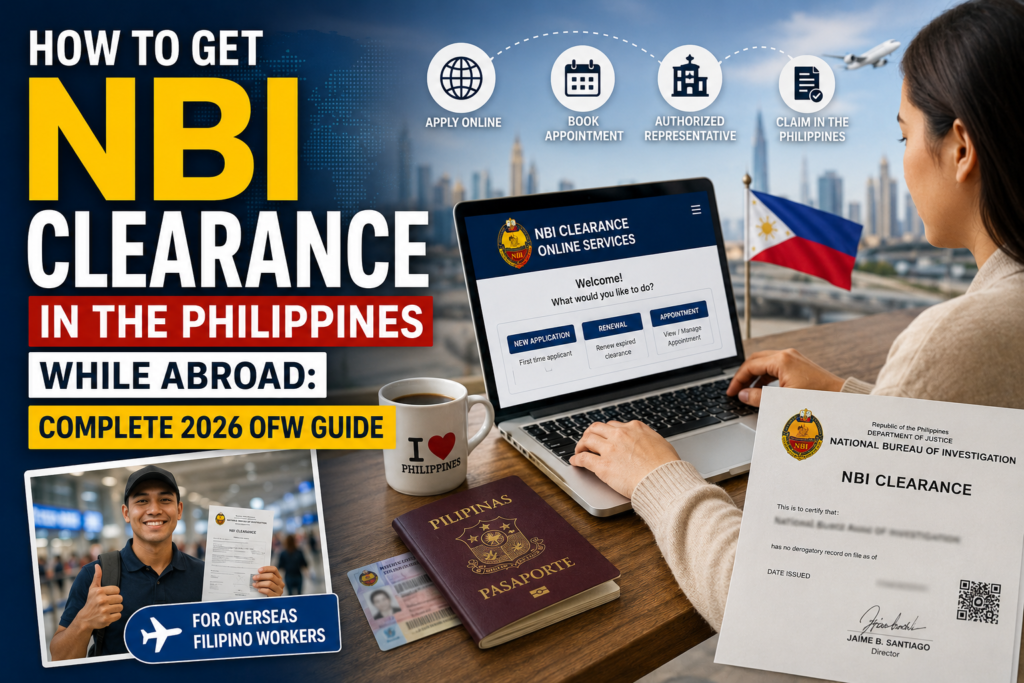
The entire process can be visualized as a three-stage workflow. First, you, the applicant abroad, complete and authenticate your documents. Second, you send these physical, original documents to your trusted representative in the Philippines. Third, your representative submits them at an NBI branch, pays the fee, and claims the clearance. The process is entirely paper-based and legal. There is no online interview or video call. The NBI trusts the authenticity of your fingerprints and signature because they have been verified and sealed by a Philippine foreign service officer. This chain of trust is the legal backbone of the remote system. It is a proven method used by thousands of OFWs and Filipino immigrants every year. Understanding this high-level workflow removes the anxiety of the unknown and allows you to focus on executing each stage correctly.
NBI Form No. 5: The Key Document for Applicants Abroad
NBI Form No. 5 is officially titled the “Application for Clearance for Persons Abroad.” It is the single most important piece of paper in your application. This form replaces the in-person biometric capture that local applicants undergo at an NBI branch. It is a multi-purpose document. It captures all your personal information, including your full name, date and place of birth, your current foreign address, your Philippine passport number, and the specific purpose for your clearance. Most critically, it contains the designated boxes for your official rolled fingerprint impressions. You can download this form from the official NBI website. It is also available at Philippine Embassies and Consulates. The form must be completed with absolute accuracy, using black or blue ink. Any erasure or correction can be grounds for rejection. You must not sign the form until you are in front of the consular officer who will authenticate it. Treat this document as your remote biometrics. If the fingerprints on it are smudged, incomplete, or incorrectly taken, your entire application fails.
NBI Form No. 5 is your remote biometrics. The fingerprints on it must be clear, rolled, and complete. The form must be authenticated by a Philippine Embassy or Consulate.
How to Get Your Fingerprints Taken Correctly While Abroad
Your fingerprint impressions are the most critical and failure-prone part of the entire application. The NBI uses an Automated Fingerprint Identification System. If the system cannot read your prints, a human officer will reject the form. You must get this right. There are three reliable places to have your fingerprints captured on the NBI Form No. 5 card.
Option 1: At the Philippine Embassy or Consulate (Most Recommended)
This is the gold standard. Most Philippine Embassies and Consulates offer fingerprinting services specifically for NBI Clearance applications. The staff are trained in the exact NBI requirements. They know how to take rolled impressions correctly. They use the proper fingerprint ink and have the official NBI card forms. The cost is typically a consular service fee, which is the best investment you can make for a successful application. This method has the lowest rejection rate.
Option 2: At a Local Police Station in Your Host Country
You can visit a local police station and request to have your fingerprints taken. You must bring your own downloaded and printed NBI Form No. 5. The police officer must capture rolled impressions, not flat scans. The officer must sign the card and provide their official details. After this, you must take the signed card to the Philippine Embassy for authentication. The embassy will not authenticate unsigned police fingerprint cards.
Option 3: Through a Private, Accredited Fingerprinting Agency
In many countries, private agencies offer legal fingerprinting services for immigration and background check purposes. Ensure the agency is a recognized and certified entity. The Philippine Embassy in your jurisdiction must accept their work for authentication. Confirm this with a phone call or email to the embassy before you pay for the service.
Critical Fingerprint Rules: The impressions must be rolled, not flat. Each finger is rolled from nail to nail. All ten fingers must be clearly captured. A simultaneous impression of the four fingers of each hand is required at the bottom of the card. The ink must be dark but not smudged. A rejected fingerprint card means restarting the entire process, paying new authentication fees, and losing valuable weeks.
The Special Power of Attorney (SPA) Requirement
A Special Power of Attorney is the legal document that empowers your representative in the Philippines to act on your behalf. This is not a simple letter of authorization. The NBI strictly requires a formal, notarized, and consularized SPA. The document must explicitly state that you are granting your representative the specific authority to apply for, process, pay for, and claim your NBI Clearance from the National Bureau of Investigation. A general SPA for banking or property is not acceptable. The SPA must include your full name, your passport number, your foreign address, and the complete name and address of your representative. You will draft and sign this document. The Philippine Embassy or Consulate will notarize your signature and then authenticate the document. This two-step process transforms the SPA into a legally binding instrument that the NBI in the Philippines will honor. Your representative must present the original, authenticated SPA. A photocopy is not accepted.
Getting Your Documents Authenticated at the Philippine Embassy
The Philippine Embassy or Consulate serves as the official bridge between you and the Philippine government. Their authentication seal, often called an “Apostille” or a “red ribbon,” is what validates your remote documents. You will typically need to book an appointment at the consular section of the Philippine Embassy. Bring your completed but unsigned NBI Form No. 5, your draft SPA, your valid Philippine passport, and the applicable consular fees. In front of the consular officer, you will sign both documents. The officer will then notarize the SPA and affix the authentication certificate to both the NBI Form No. 5 and the SPA. This process confirms that the documents were signed by you, a verified Filipino citizen, in the officer’s presence. Without this authentication, the NBI in the Philippines will reject the documents outright. Check the specific website of your local Philippine Embassy for the exact fee schedule, appointment process, and processing time for authentication services, as these vary from post to post.
Complete Document Checklist for Your Representative
Your representative will walk into the NBI branch with a physical packet of documents. A single missing page means failure. Use this checklist to ensure your package is perfect.
| Document | Key Condition | Purpose |
|---|---|---|
| Original NBI Form No. 5 | Embassy-authenticated with clear, rolled fingerprints | Your remote application form and biometrics. |
| Original Authenticated SPA | Notarized and consularized by the Philippine Embassy | Legal authority for your representative to act. |
| Clear Photocopy of Passport Data Page | Passport must be valid and not expired | Proof of your identity and citizenship. |
| Online Appointment Reference | Printed or clear digital screenshot | Proof of the scheduled NBI transaction. |
| Representative’s Two Valid IDs | Original, valid government-issued IDs | For identity verification of the person claiming the clearance. |
Choosing and Authorizing Your Representative in the Philippines
Your representative is your physical proxy. Choose this person with care. It must be someone you trust absolutely, as they will handle your sensitive personal documents and legal instruments. The best representatives are immediate family members: a parent, a spouse, a sibling, or an adult child. The representative must be physically present in the Philippines on your appointment date. They must be willing and able to travel to the specific NBI branch you have chosen. They must possess at least two original, valid government-issued IDs. A PhilSys National ID, Driver’s License, UMID, PRC ID, or a valid Philippine Passport are ideal. They must be detail-oriented enough to present the documents correctly, answer basic questions, and follow the process through to claiming the physical clearance. The representative’s full legal name must be spelled correctly in the SPA. Any mismatch between the SPA and their IDs will result in a rejection.
Step-by-Step Process: How to Get Your NBI Clearance While Abroad
This is the definitive workflow. Follow every step in order.
Step 1: Book an NBI Online Appointment from Abroad
Go to the official NBI Clearance portal. Create an account under your name. Fill in your details exactly as they appear on your passport. For the purpose, select Employment (Abroad) or the specific purpose required. Book an appointment at the NBI branch most convenient for your representative. Secure the reference number. You can also refer to our NBI Clearance online application guide for help.
Step 2: Download and Prepare NBI Form No. 5
Download the official NBI Form No. 5. Fill it out completely with accurate, error-free information. Do not sign it yet.
Step 3: Draft Your Special Power of Attorney
Prepare the SPA document. It must specifically authorize your named representative to apply for and claim your NBI Clearance. You can find templates online, but ensure they are comprehensive.
Step 4: Complete Fingerprinting and Consular Authentication
Go to your Philippine Embassy or Consulate appointment. Have your fingerprints taken on the NBI Form No. 5. Sign both the form and the SPA in front of the consular officer. Pay the authentication fees. Obtain the authenticated, sealed documents.
Step 5: Courier the Physical Documents to the Philippines
Use a secure, tracked international courier like DHL, FedEx, or LBC. Send the original authenticated NBI Form No. 5, the original authenticated SPA, and a clear photocopy of your passport to your representative. Do not use ordinary postal mail for these irreplaceable originals.
Step 6: Instruct Your Representative to Submit and Claim
On the appointment date, your representative goes to the NBI branch with the complete packet of documents, the reference number, and their two IDs. They submit the package, pay the ₱155 fee, and either claim the clearance on the same day or receive a return date if a HIT occurs.
Step 7: Have the Clearance Couried Back to You
Once claimed, your representative must courier the physical NBI Clearance to your address abroad using a secure, tracked service. Keep the tracking number and monitor the delivery.
What Your Representative Must Do at the NBI Branch
Your representative’s role is critical. On your appointment day, they must arrive at the NBI branch early. They should bring all your original, authenticated documents, the printed appointment confirmation with your reference number, and their own two original valid government IDs. At the verification counter, they should clearly and politely state that they are submitting a remote application for an applicant abroad under the NBI Form No. 5 process. They will hand over the entire document packet. The NBI officer will scrutinize the fingerprints and the SPA. If all is in order, the officer will process the application. The representative will be directed to pay the ₱155 fee at the cashier. After payment, if there is no HIT, the clearance is printed and released shortly after. Your representative must present their ID again to claim it. They must check the printed clearance for any spelling errors before leaving the branch. If a HIT occurs, they must be prepared to return on the specified date to claim it. Provide your representative with a small fund for transportation and incidental expenses. Their time and effort are invaluable.
Total Costs and Fees Breakdown
The total cost of getting an NBI Clearance while abroad is significantly higher than the local ₱155 fee due to the consular and logistical expenses. Budgeting correctly prevents financial surprises.
| Cost Component | Estimated Amount | Remarks |
|---|---|---|
| NBI Clearance Fee | ₱155 | Fixed, paid by your representative at the NBI branch. |
| Embassy Authentication Fee (per document) | $25 – $50 USD | Fee for authenticating NBI Form No. 5 and SPA. Varies per embassy. |
| Embassy Fingerprinting Fee | $10 – $25 USD | Additional fee if the embassy captures your fingerprints. |
| International Courier (to Philippines) | $30 – $60 USD | For sending documents to your representative. |
| International Courier (back to you) | $30 – $60 USD | For your representative to send the clearance to you. |
| Total Estimated Cost | $95 – $195 USD + ₱155 | A significant but necessary investment. Plan for it. |
The NBI fee itself is explained in detail in our NBI Clearance fee guide. The consular fees are set by each Philippine foreign service post and can be found on their official websites.
Processing Time, HIT Status, and Release
The processing time depends entirely on the NBI’s name-matching system. If your name is unique and generates no HIT, your clearance will be released on the same day your representative submits the documents. This is the best-case scenario. A HIT occurs when your name matches a name in the NBI’s criminal database. This is not an accusation of a crime. It is a routine flag for manual verification, especially common with common Filipino surnames. A HIT will delay the release by 5 to 10 working days. Your representative will be given a slip with a specific return date. You must then wait and have them return to claim the clearance. This is why you must never leave your application to the last minute. The combination of courier transit times, embassy appointment lead times, and a potential HIT delay means you should start the entire process at least 6 to 8 weeks before you actually need the physical document in your hand. Read our detailed explanation in the NBI Clearance HIT status guide.
Special Scenarios: Seafarers, Balikbayans, and First-Time OFWs
Seafarers and Mariners
Seafarers face a unique logistical challenge due to their highly mobile work environment. The core legal process using NBI Form No. 5 remains the same. Often, the seafarer’s licensed manning agency in the Philippines acts as the official representative. The seafarer must seize the opportunity at the next port of call to find a local authority or a Philippine consulate to capture their fingerprints on the NBI card and authenticate the documents. Close, proactive, and early coordination with the manning agency’s liaison officer is essential. Do not leave this until the last port before your contract ends.
Balikbayans (Filipinos Visiting the Philippines)
If you are a Filipino citizen who is visiting the Philippines for a vacation, you are in the most advantageous position. Do not use the remote process. The moment you are in the country, apply for your NBI Clearance in person. Book an online appointment, visit an NBI branch yourself, and complete your biometrics. This is far cheaper, far faster, and completely bypasses the consular authentication and courier process. Treat this as a priority task during your visit home.
First-Time OFWs
If you are a first-time job seeker preparing for your first deployment, you may qualify for a free NBI Clearance under Republic Act 11261. However, the free benefit applies to the NBI fee only. The consular authentication fees and courier costs will still need to be paid. Check your eligibility in our first-time job seeker NBI Clearance guide.
Common Mistakes That Cause Rejection
- Smudged or Incomplete Fingerprints: This is the most frequent and devastating error. The NBI’s system must be able to read every print. A single smudged box can result in total rejection.
- Unnotarized or Unauthenticated Documents: Sending an SPA that was signed but not notarized by the Philippine Embassy is a guaranteed failure. The NBI requires the consular seal.
- Expired Philippine Passport: All documents are tied to your valid passport. If your passport has expired, your NBI Form No. 5 is invalid. Renew your passport at the Embassy first.
- Mismatched Representative Name: The name of the representative on the SPA must be exactly the same as the name on their valid IDs. A nickname or a missing middle name will cause a rejection.
- Booking the Wrong Appointment Purpose: The appointment on the NBI portal must be for “Employment (Abroad)” or the specific purpose you need. A local employment purpose will not match your overseas application.
Expert Tips for a Successful Remote NBI Clearance Application
- Start the Process 6 to 8 Weeks Before Your Deadline: This is the single most important rule. The timeline must absorb embassy appointment wait times, international courier transit, and a 10-day HIT delay. A last-minute application will fail.
- Always Use the Philippine Embassy for Fingerprints: Pay the embassy’s fee to have your fingerprints taken by their personnel. Their work is perfectly aligned with NBI standards and virtually eliminates the risk of fingerprint rejection.
- Use a Dedicated, Premium Courier Service: Never risk original, authenticated, irreplaceable legal documents with unreliable postal services. DHL, FedEx, and UPS provide tracking, insurance, and accountability. This is not an area to save money.
- Create a Document Packet Checklist for Your Representative: Write a clear, simple cover letter listing each document in the packet. Instruct your representative to check each item against the list before leaving for the NBI branch. This prevents a simple oversight from wasting an entire appointment.
- Proactively Manage Expectations with Your Employer: Inform your foreign employer or the requesting immigration agency that an NBI Clearance from the Philippines is being processed and that a HIT status can cause a two-week administrative delay. Professional, upfront communication prevents misunderstandings.
Frequently Asked Questions About Getting NBI Clearance While Abroad
Can I really get an NBI Clearance without going back to the Philippines?
Yes. The official NBI Form No. 5 process, combined with a Special Power of Attorney and Philippine Embassy authentication, is the legally recognized method for remote applications.
What is NBI Form No. 5?
It is the official NBI application form for Filipinos abroad. It captures your personal information and holds your rolled fingerprint impressions in lieu of in-person biometric capture.
Where can I get my fingerprints taken abroad?
The Philippine Embassy or Consulate is the best option. You can also use a local police station or an accredited private agency, but the fingerprints must be authenticated by the Embassy.
Do I really need a Special Power of Attorney (SPA)?
Yes. A simple letter of authorization is not accepted by the NBI. The SPA must be notarized and consularized by the Philippine Embassy.
Who can be my representative in the Philippines?
Any trusted person, ideally an immediate family member, who is in the Philippines, has at least two valid government-issued IDs, and can physically go to the NBI branch on your appointment date.
How much does the whole process cost?
Budget between $95 and $195 USD for consular fees and courier services, plus the ₱155 NBI fee. The cost varies by country and specific embassy fees.
How long does it take to process an NBI Clearance from abroad?
If there is no HIT, the clearance is released the same day the documents are submitted. A HIT causes a delay of 5 to 10 working days. Plan for a total timeline of 6 to 8 weeks including courier and embassy appointments.
What happens if my fingerprints are rejected by the NBI?
Your representative will be notified. You must redo the entire NBI Form No. 5 with a new, clear set of fingerprints, have it authenticated again, and resubmit. This is the worst-case delay scenario.
Can I use an expired NBI Clearance for my application?
No. An NBI Clearance is valid for one year. An expired document is invalid and cannot be used for any official purpose, including contract renewal or visa application.
Can I pay the NBI fee online from abroad?
You can, but it’s often simpler for your representative to pay the ₱155 fee over the counter at the NBI branch during submission. Include the cash for the fee in the package you send them.
What is an Apostille, and do I need it?
The Apostille is the international authentication certificate issued by the Philippine Embassy. It verifies the authenticity of your documents for use in the Philippines. It is the replacement for the old “red ribbon.” Yes, you need it.
I am a seafarer. How can I do this while at sea?
Coordinate with your manning agency in the Philippines. They often serve as your representative. Get your fingerprints done at the next port with a Philippine consulate or a reliable local authority, and courier them to your agency.
Can I use my NBI Clearance for any purpose?
The purpose you select during the online application is printed on the clearance. An employment clearance cannot be used for a visa, and vice versa. Select the exact purpose required.
Is this website an official NBI site?
No. NBIOnlineClearance.ph is a private, independent informational guide. We are not affiliated with the NBI, DFA, or any government agency. For official transactions, visit clearance.nbi.gov.ph.
Why Trust This Guide
Our Commitment to Accuracy: This guide is the product of rigorous research into the official NBI remote application process, consular procedures, and the real-world experiences of Filipino applicants worldwide.
Editorial Review and Fact-Checking
All procedures, including the use of NBI Form No. 5, SPA requirements, and Philippine Embassy authentication, have been fact-checked against official NBI and DFA guidelines. We are an independent resource committed to providing accurate, clear, and actionable information for Filipinos abroad. Read our editorial policy to learn more.
Official References
For binding information and to access the official forms, always consult these primary government sources:
- National Bureau of Investigation (NBI): clearance.nbi.gov.ph for online appointments and NBI Form No. 5 downloads.
- Department of Foreign Affairs (DFA): For the official list of Philippine Embassies and Consulates and their contact details.
- Your Local Philippine Embassy or Consulate Website: For specific appointment booking, fee schedules, and authentication service hours.
Structured Data Recommendations for Webmasters
To maximize this page’s visibility in search and AI-generated answers, implement these Schema.org types via JSON-LD:
- Article Schema: For headline, author, and key dates.
- FAQ Schema: To make the FAQ section eligible for rich results and voice search.
- BreadcrumbList Schema: To define the site’s navigation path.
- HowTo Schema: To mark up the detailed step-by-step application process.
- Speakable Schema: To optimize the quick answer and key takeaways for voice assistants.